Table of Contents
ToggleDetails about Scientists and Best Contributions of Scientists in the Science:
The following list of Scientists names having details about Scientists and their contributions in Science. Clink on the Scientists Name and get the details.
About Scientist Newton and his inventions / contributions in Science
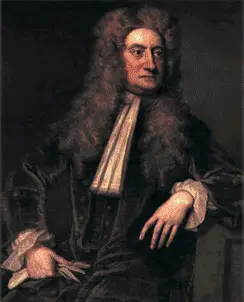
Born on: 25th Dec, 1642. Died on: 31st March, 1727.
Isaac Newton was a Physicist and Mathematician, one of the greatest Scientists of all time. His theoretical illustrations and practical revolutionized scientific thinking. His scientific works were the most important works in the history of Modern Science. So some people were recognizing him as a Father of Physics. (Some are recognized Galileo Galilei as Father of Physics. Reason: He is the first Scientist who introduced inertia in motion i.e explain the law of inertia, proved experimentally that acceleration due to gravity is constant irrespective of the size and shape of the bodyand he is elder than Newton).
His contributions are
- Law of gravitation which explains about the attractive force between any two massive bodies.
- Three Laws of Motion. (1. Law of Inertia, 2. About external for and acceleration of the body and 3. for Every action-equal and Opposite reaction).
- Designed Reflecting Telescope.
- He was the first person who showed the white light consists of 7 colors, spectrum (VIBGYOR).
- Worked a lot to designed a new branch of mathematics called Calculus.
- Designed Newton Interpolation theorems in Mathematics.
- Studied about Interference of light and practically showed interference pattern which is now calling as Newton rings in interference.
- Studied about light and explained Newton Corpuscular Theory which supports the particle nature of Light.
- Studied about Sound and designed an expression for the Velocity of Sound.
- One of his famous books – Principia Mathematica.
Due to his contributions in many areas of science, after his death, on his tomb, he designed a quote ‘ INVALUABLE GEM TO THE MANKIND‘.
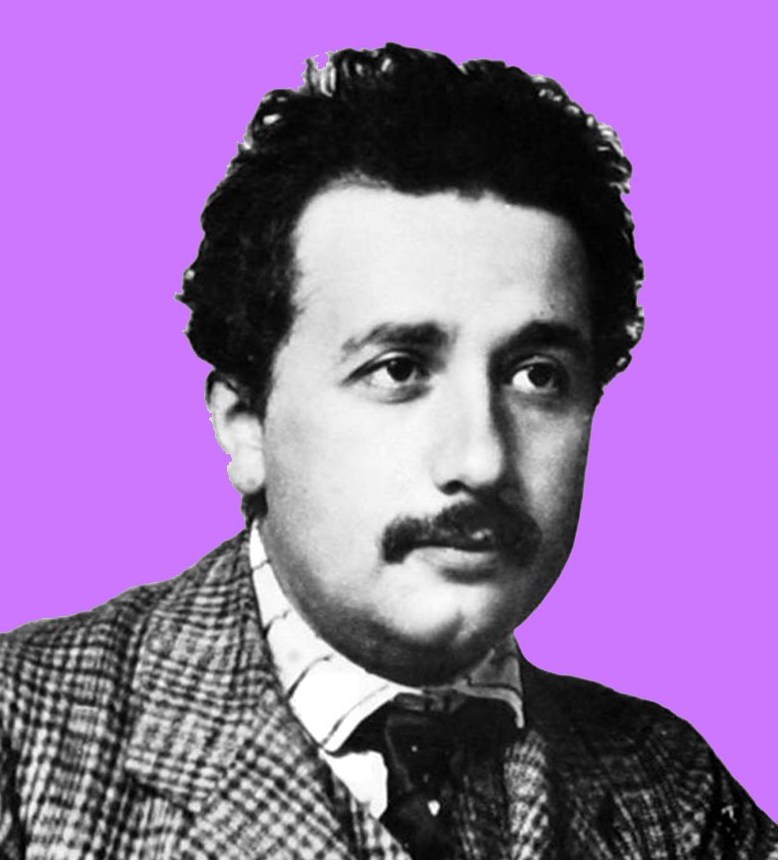
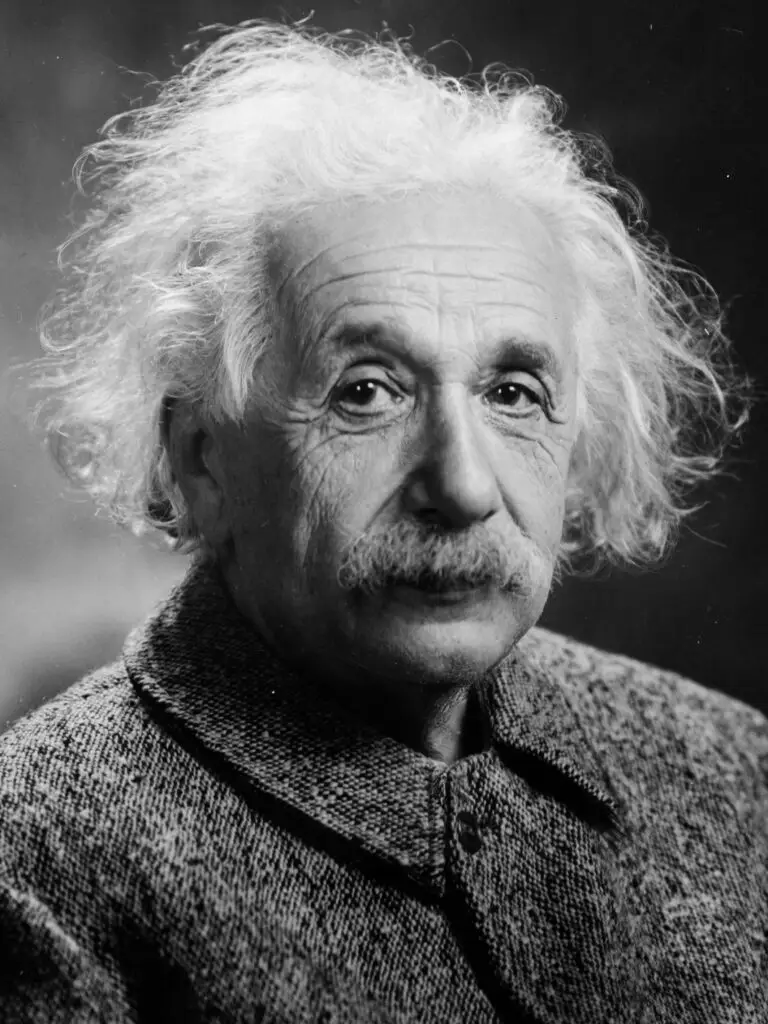
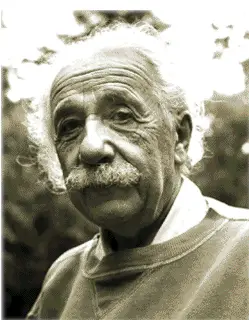
Born on: 14th March, 1879. Died on: 18th April, 1955.
- Albert Einstein born in Germany in the year 1879.
- He got Noble Prize in the year 1921 for the invention of Solar Cell – a device that can convert light energy into electrical energy.
- Einstein designed Photo Electric Equation to explain the photoelectric effect.
- In the year 1905, he published three papers, which are path-breaking at that time.
- So, after 100 years, the year 2005 was declared as the International Year of Science.
- The first one about light Quanta (now calling as a photon), which is used to explain about Photo-Electric Effect.
- The second one about Brownian Motion.
- The third one is SPECIAL THEORY OF RELATIVITY which made Einstein more popular.
- He also created General Theory of Relativity which is also called the Modern theory of Gravitation.
- He designed Mass-Energy equivalent equation E = mC2.
- Einstein is also called as Father of Modern Physics.
- He worked with SN Bose and designed Bose-Einstein Statistics which explains about Bosons, integer spin particles.
- Along with Debye, Einstein designed Debye-Einstein’s theory which gives details about specific heat of the solids with respect to temperature.
Video Lectures about Scientists and their Contributions in Science:
Details about 1st Women Physics Scientist and her Contributions in Science - Madam Curie:
Born on: 7th Nov, 1867. Died on: 8th July, 1934.
Marie Curie and her husband Pierre were famous for their scientific work on Radioactivity. Madam Curie inspired by the work of the French physicist Henri Becquerel (Father of Natural Radioactivity). Due to her contributions to Physics and Chemistry, she got two Noble Prizes, one in Physics got along with her husband and the other one got alone in Chemistry for the discovery of POLONIUM. She is the first woman who got two Noble Prizes and the first woman who got Noble Prize in Physics as well as in Chemistry so far. Not only Madam Curie and Pierre, her daughter and son-in-law also got Noble Prizes. So the entire family was calling as Noble Family.
Contributions:
- Marie curie was the first person to use the term radioactive which is the famous word now in nuclear physics.
- Curie discovered a new element and named as Polonium, taken from Poland (Which was reflecting the patriotism of Curie, she belongs to Poland)
- She isolated two radioactive elements Polonium and Radium.
- She did more research to develop user-friendly radioactive elements to mankind in Medicine.
- Marie Curie did research on ferromagnetic materials and identified the effect of temperature on the magnetic susceptibility of ferromagnetic materials.
- She is the first woman to teach physics at Sorbonne University in Paris.
- Marie Curie got the first Noble Prize for physics in 1903 and for chemistry in 1911.