Electric Charges and Fields – 1 Mark Questions
Very Short Answer Questions in Electric Charges and Fields Lesson in Inter Second Year / Class 12:
1 Mark Questions
- Why do the electrostatic field lines not form closed loop?
- Why do the electric field lines never cross each other?
- Why must electrostatic field be normal to the surface at every point of a charged conductor?
- Why must electrostatic field at the surface of a charged conductor be normal to the surface at every point? Give reason.
- Two point charges q1and q2are placed at a distance of ‘d’ apart as shown in figure. The electric field intensity is zero at the point P on the line joining them as shown. Write two conclusions that you can draw from this.

- Define dipole moment of an electric dipole. Is it a scalar quantity or a vector quantity?
- Draw a plot showing the variation of electric field (E) with distance rdue to a point charge Q.
- A proton is placed in a uniform electric field directed along the positive X-axis. In which direction will it tend to move?
- In which orientation, a dipole placed in a uniform electric field is in
i. Stable and
ii. Unstable equilibrium? - Two point charges having equal charge separated by 1 m distance experience a force of 8 N. What will be the force experienced by them if they are held in water at the same distance? (Given K water = 80).
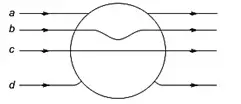
- A metallic sphere is placed in a uniform electric field as shown in the figure. Which path is followed by electric field lines and why?
- Point out right or wrong for the following statement.
The mutual forces between two charges do not get affected by the presence of other charges. - A dipole of dipole moment p is present in a uniform electric field E. Write the value of the angle between p and E for which the torque experienced by the dipole, is minimal.
- Consider two hollow concentric spheres, S1 and S2, enclosingcharges2Qand 4Qrespectively as shown in the figure.
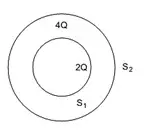
(i) Find out the ratio of the electric flux through them.
(ii) How will the electric flux through the sphere S1changeif a medium of dielectric constant ‘εr’ is introduced in the space inside S1inplace of air? Deduce the necessary expression.
- Two charges of magnitude – 2Q and + Q are located at points (a, 0) and (4a, 0), respectively. What is the electric flux due to these charges through a sphere of radius 3awith its centre at the origin?
- A charge q is placed at the centre of a cube of side l. What is the electric flux passing through each face of the cube?
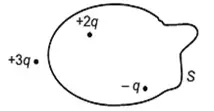
- Figure shows three point charges, + 2q, – q and +3q. Two charges+2qand – q are enclosed within a surface ‘S’. What is the electric flux due to this configuration through the surface ‘S’?
- Define electric flux. Write its S.I. units.
- A charge q is enclosed by a spherical surface of radius R. If the radius if reduced to half, how would the electric flux through the surface change?
- State the Gauss law of electrostatics.